
On this page
What downspouts do
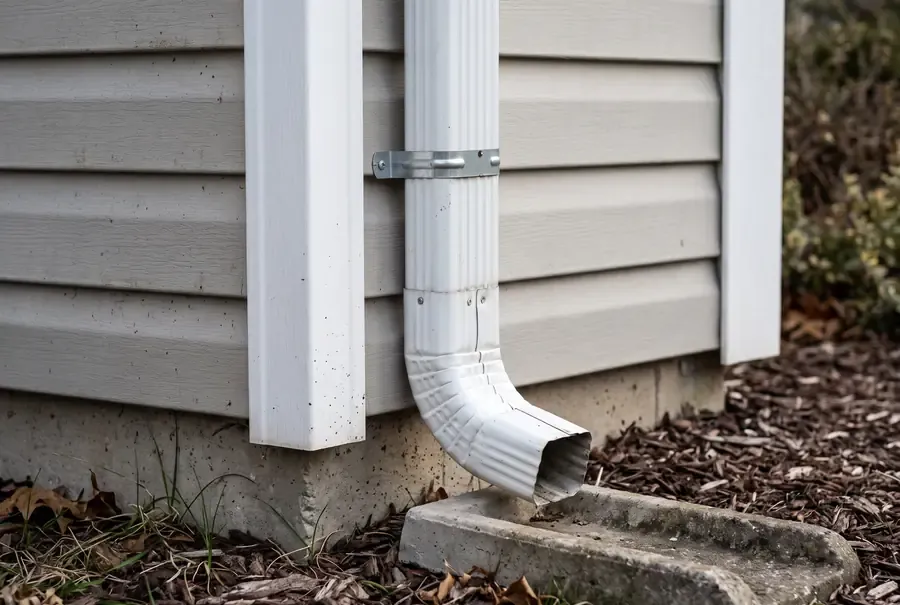
A downspout carries water from the gutter outlet to the ground, and its job is not finished until the water is somewhere it cannot harm the house. In Nashville, where many houses sit on clay soil over limestone karst, where the water lands decides whether crawlspaces stay dry and foundations stay stable.
How much do downspouts cost?
Downspouts are usually priced as part of a gutter installation, per downspout or per foot of leader. Extensions and underground lines are priced separately. Costs depend on height, size (2x3 vs 3x4), material and how far the water needs to be carried. The contractor's quote will itemize them.
2x3 vs 3x4 downspouts
| 2x3 | 3x4 | |
|---|---|---|
| Typical gutter | 5-inch K-style | 6-inch K-style |
| Flow capacity | Lower | Much higher |
| Clogging | Clogs more easily | Clogs less often |
| Look | Slim | Slightly larger |
Placement
A good layout puts:
- an outlet at each end of long runs, or one in the middle so water flows both ways;
- an outlet close to every valley;
- downspouts on corners where they are out of the way of doors and walkways; and
- discharge points on ground that slopes away from the house.
Too few outlets is a common cause of heavy-rain overflow.
Where the water goes
| Option | How it works | Best for |
|---|---|---|
| Splash block | Concrete or plastic tray under the elbow | Short distance; sloped lawns |
| Extension | Extra length of downspout or flexible pipe | Moving water several feet out |
| Tightline | Solid buried pipe to a pop-up emitter or daylight outlet | Carrying water well away on flat lots |
| Dispersion trench | Gravel trench that spreads water into the soil | Where soil can absorb it |
| Rain barrel | Stores water for gardens; overflow must be routed | Gardens; reducing runoff |
| Rain garden | Planted shallow basin that soaks up water | Larger volumes; Metro recommends |
Metro Water Services recommends re-directing downspouts away from hard surfaces toward areas where water can soak into the ground, and planting rain gardens. See rain barrels and rain gardens.
Downspouts and Nashville soils
Clay soils absorb water slowly and swell when wet. Water dumped beside a foundation can keep that soil saturated, and in karst areas water can follow cracks in the rock below. Metro Water Services also notes that runoff from one private property to another is a matter between property owners, not the city, so aiming downspouts at a neighbor's yard can cause disputes.
Common downspout problems
| Problem | Fix |
|---|---|
| Downspout empties beside the foundation | Extension, splash block or tightline |
| Elbow clogs with seed pods | Larger 3x4 downspout; downspout strainer; guards |
| Crushed by a mower or car | Replace with heavier leader; add a downspout guard |
| Buried line backs up | Flush or snake the line; replace if crushed |
| Loose from the wall | New straps screwed into masonry or framing |
See downspout repair.
Questions to ask
- How many downspouts, and where?
- 2x3 or 3x4?
- Where will each one discharge?
- Do any existing buried lines need flushing or replacing?
- Can a rain barrel or rain garden take some of the water?
An illustration: a flat lot in Antioch
On a flat lot with a crawlspace, two downspouts at the back corners empty onto splash blocks that have sunk into the lawn. In storms, water spreads back toward the house and the crawlspace vapor barrier is wet every spring.
A sensible fix: replace the splash blocks with solid buried lines running 10 to 20 feet out to pop-up emitters on the lowest part of the yard, upsize to 3x4 downspouts with a cleanout above ground, and keep the outlets clear. Metro Water Services encourages sending downspout water to lawns and gardens where it can soak in.
Related: downspout drainage and your foundation.